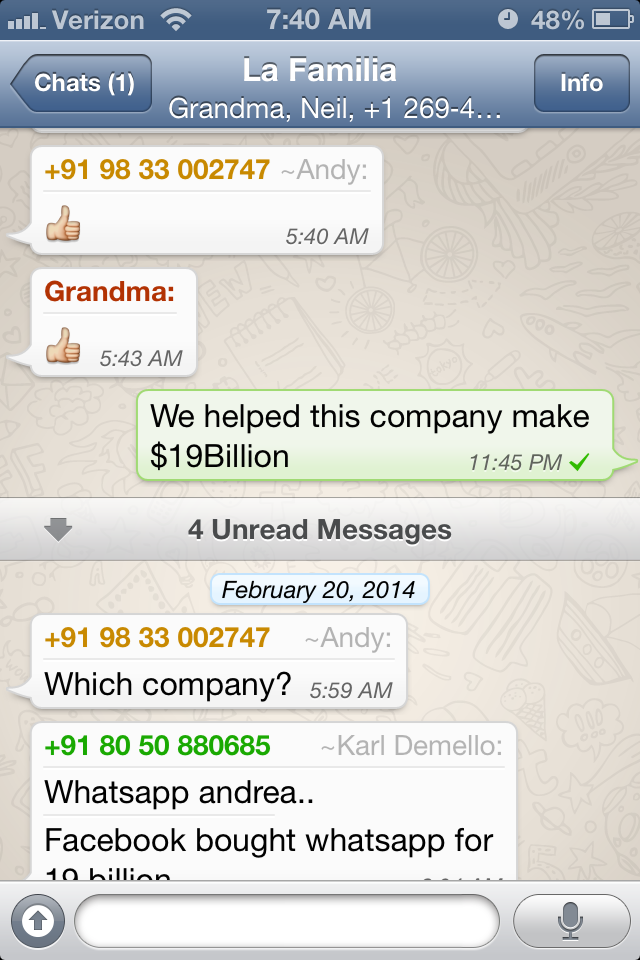
I wake up every morning around 4am, if only for a few minutes, because of this app I recently downloaded. I live in Kentucky and keep odd hours compared to most, but the app is no alarm clock, it is a messaging service that is called WhatsApp and the reason it goes off at 4am is because my family in India begin group messaging each other around that time. The timing isn’t ideal, but I haven’t turned off the notifications because
1) I am lazy (I think I am still using the original OS for my iPhone 4)
2) I miss my family.
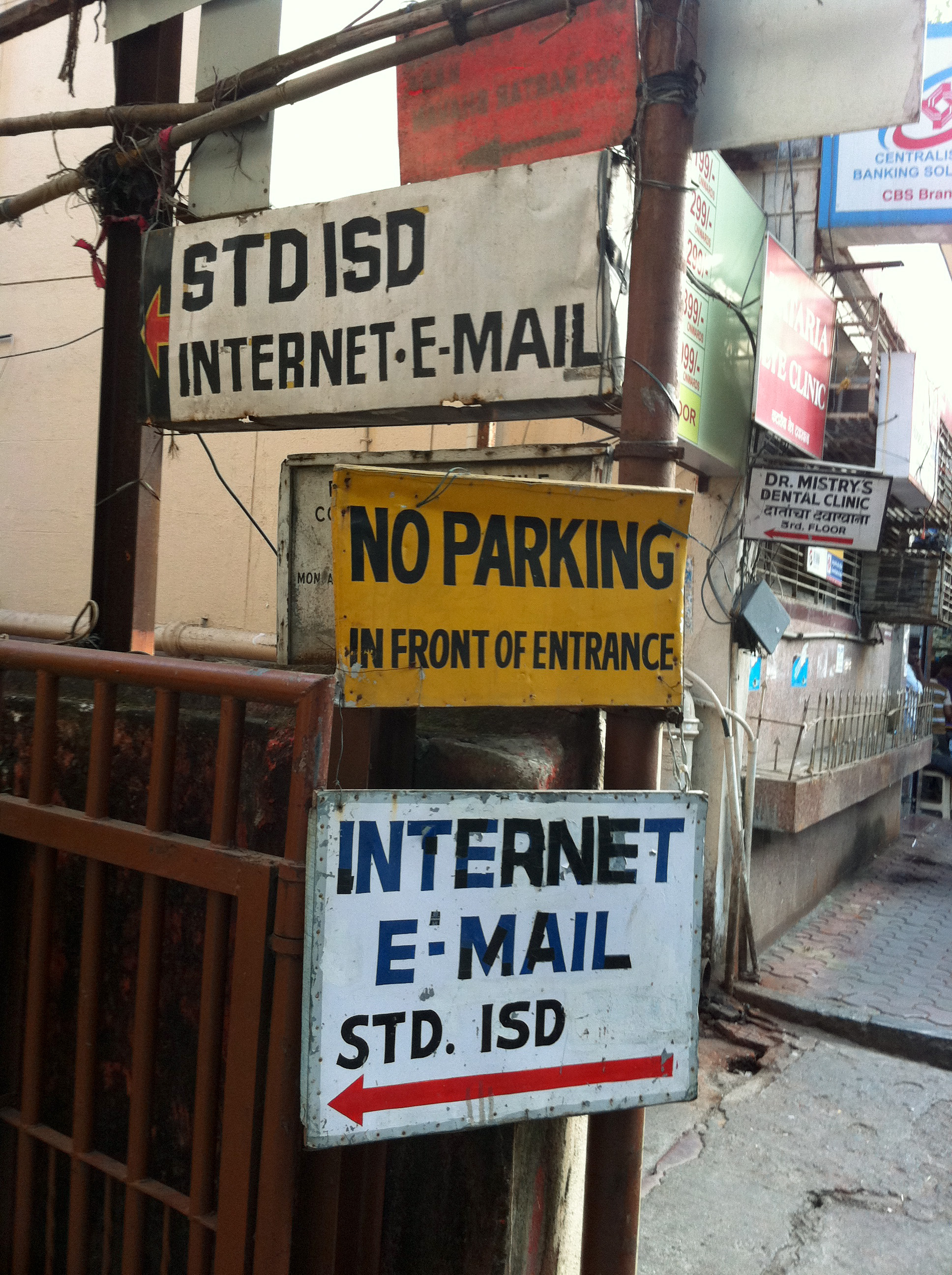
My experience with understanding advancements in phone technologies have usually revolved around the ease and affordability of keeping in touch with these relatives. As a kid I remember we had to call an operator to connect us, and once connected we would speak really fast to each other and pass the phone to the next. Sometimes my relatives would have to walk down to a phone booth with a sign saying “STD” which I never really understood. We eventually moved over to calling cards, then to calling card services that didn’t even require a card. As a teenager we started experimenting with internet phone services, which which sometimes worked, but usually took more time than it seemed to be worthwhile. Of course, there was AIM, which I pleaded my cousins to join when I visiting them, but it never really took off. They created yahoo messenger and hotmail accounts for me, which I rarely logged on to use. Skype was exciting, but again, the connection was spotty. Last Thanksgiving things seemed to really improve, allowing for  a 3 continent simultaneous musical jam session over skype and facetime using several ipads.
And then my Grandmother, who lives in a small village in Goa, India, demanded over the phone that I download this app that she just got for her new smartphone. I obeyed, and entered a world of unlimited communication at no expense. This world was available to us before, but had never been made to be so simple and so instant. My father, who has refused to adopt a cell phone was the only person left out of the conversation, but he would join in at times through my mothers phone and crack jokes and keep up with our banter. It may have been the only time he’s truly desired to have his own cell phone, but he is yet to cave in.
When I heard that this app sold for $19 Billion last night, I thought my VC friend who posted the news was making a joke. And then my laugh turned into panic. I’ve been paranoid about overvaluations of startups since I left California 3 years ago. This is perhaps the biggest case of it, and as an aspiring educator of entrepreneurship, I am frightened.
WhatsApp was a great service that leveraged mobile data plans and wifi services to make international communications feel like they are free. They boast 50 billion texts per day sent over the app, 450 million active users (with fastest user acquisition in history), only 32 engineers supporting 14 million of us users each, and zero dollars spent on marketing. The service is free of advertising, and costs $1/year after a free year of service. The valuation of $19B is similar to how a drug would be priced in M&A transaction. The article states:
“Only 35 U.S.-based publicly traded companies have a price-sales ratio of 19 or higher, according to data compiled by Bloomberg based on analysts’ estimates for three years from now. All are in the biotechnology or pharmaceutical industry, including companies such as Puma Biotechnology Inc., which has an experimental breast-cancer treatment, the data show.”
When people didn’t understand why Snapchat turned down the $3B offer from Facebook, I quietly gave a sigh of relief, realizing that the relief was very temporary. It’s not that I don’t like seeing entrepreneurs getting rich. I am just having a tough time understanding the prices. And while the strategic motivation for Facebook to seek to acquire these startup apps that have quickly grown a younger, international user base, I just don’t believe that they can invent business models to bring a return to these investments to bring value to their shareholders in the long run. I hope I am wrong.
WhatsApp has written a new narrative of the overnight success appeal of entrepreneurship. No one is talking about how this technology piggybacks on many other companies that have invested many more dollars on infrastructure that allows the technology to work. Surely the expense of sending 50 billion daily text messages will find its way back to the customer one way or the other, whether through slower internet speeds or higher priced data plans. Wasn’t it less than a month ago that people were up in arms about net neutrality?
That aside, the part I dread about this story is the attention entrepreneurs and investors are going to give to trying to get in on the next WhatsApp deal, or play in the game of Zuck-opoly  There are far too many real problems in the world that need the attention and ingenuity of our society. These problems (renewable energy, poverty alleviation, water, health etc) can still make entrepreneurs very rich, but I worry they will be harder to see when those with the deep pockets who missed out on this deal use lenses of hindsight for evaluating future  opportunities.
I am thankful to the founders of WhatsApp for their stories – one being the immigrant story of wanting to avoid  government monitoring of communications while staying in touch with family in Russia and the Ukrain, and other other being a story about a his mentor, an entrepreneur snubbed by Silicon Valley who got the last laugh. It will be a great movie. They put me in better contact with family, and that is a tough luxury to value. But it is a luxury, and one that is probably not going to remain free for much longer. A handful of people made a fortune on this deal, and I just hope they use some of those profits to invest in innovation that will bring long-term, sustainable value to this world.
But I will be texting a link to this article to my grandmother via WhatsApp, and sharing the link over Facebook. So, I guess I am as bad as the next.
It’s the moment you decide to remove your feet from the ground. And as your knees buckle and your calves elevate your body, you duck your head to prevent an unnecessary injury from colliding with the only roof in sight. Your two hands lead your arms in uncoordinated but celebratory rhythms around and up and down. Your voice makes sounds you would otherwise be embarrassed from.
And as I get excited about the win, I am surrounded by Winners who needed this victory just as much as I did. As our fallen comrade cut the last part of the net, I thought about the courage that resides within this city of Louisville
I thought about how this tournament was the narrative example for how anyone in this sport can make a difference. And that idea of potential is so powerful. The notion that anyone on a squad that is privileged to wear the uniform can discover their talent in front of millions of eyes is the beauty of collegiate sports. And that even the tragedy of a player on the cusp of discovering this same talent can stumble into an earthquake of an injury in front of the same volume of eyes, can positively move an entire nation into the most bipartisan form of compassion of our decade. Sometimes in the complexity of the world we live in, the simplicity of sports can help bring a little sense into our lives.
This day is about Winners. I am inspired about watching my team win while in the company of said Winners. I know that Louisville is branded as the possibility city, however we ought to be careful not to limit ourselves into being too future oriented. We need to celebrate the victories of the past, and more importantly those of the present. Rather than imagine what we may become, I would rather investigate what we already have.
Today, the world saw this team reach their predicted potential. The label on the jerseys worn deserve many other rankings, such as a leading city for the Maker Movement, or the national example for fostering entrepreneurship within refugee communities, the best farm-to-table food sourcing in America, or, most importantly, a city responsible for heavy dancing through our design of genre lights otherwise known as disco balls. Our championship in basketball is among so many other wins Louisville has made in recent years.
As I watched this Cardinal team work hard to defeat my sworn enemy, the Michigan Wolverines (skunk bears), I reflected on my own Louisville story. I grew up in Michigan, however have always bled green for my Spartans. I don’t deny being chronically arrogant when it comes to in-state rivalries, yet I must admit to being humbled tonight while watching UofM challenge my paycheck writing institution with such valor. I saw a kid continue to shoot perfectly from long range, despite a night of struggles at the free throw line. I witnessed a rising star come off the bench after spending the first half of the game in foul trouble, to spending the second half sinking unreasonable three pointers and other score-making ingenuity. These Skunk Bears certainly earned their spot in this game and were not going down without a fight.
Yet, The Cardinals fought back with grit, ending the half with sharpshooting by a white bearded man who could have passed as a patron of the bar I was at. The momentum was followed by a tough defense and witty passing by the usual stars that redeemed themselves of the struggle they displayed just two days ago. The competition was everything you would want from such a championship game, and allowed the venue I watched from to show its true colors.
I was intoxicated by the excitement of celebrating this game with some of the best rock stars of our era that remain in Louisville. Some were actual rock stars, back in town from tour and taking in the game in pure joy in an environment that did not invade their privacy. Others were those who deserve their own stage for the future. Somehow, it seemed that the energy created on this deck of the Monkey Wrench found its way to Atlanta, Georgia tonight. The Winners on and off the court had much in common.
Some smelled awful, because they wore their superstitious shirts that couldn’t be washed mid-season, and spread that funky scent to any other fabric that came into its contact. Yet, these smelly Winners won thousands of dollars the day before from a novel idea around literacy and promoting creative writing in places otherwise forgotten.
The Winners tonight were those who had dedicated decades of their lives into dreams of bringing the hottest live music to town while maintaining life in the hotspots around the world at risk of environmental disasters.
Winners who fight for their bar to have fair rights to fulfill the needs of their patrons, and Winners who fight for the legal rights of other bars to who were unfairly shut down.
Winners who dream of building a new family despite nature tragically fighting back too damn hard.
Winners who paint beautiful art that they regret selling too soon in order to pay the bills.
Winners who moved to Louisville on a whim, and who are dreadfully preparing for the consequences of having to leave.
Winners filled the bar to celebrate Louisville’s win. I am sure that many bars, homes, and other places were full of the remarkable stories of the people like those that I shared this game with tonight. Tonight as our team won, many lost memories of their own losses. In the embraces after the clock ran out, feet moved up and down, shoulders collided, lips touched cheeks and sometimes other lips, and smiles inspired larger ones. None thought of this win as anyone else’s loss, but instead this win could only be thought of… as simply….. a part of our history. And I will argue that despite being hundreds of miles away from the action on the court, there is no place I would have rather been tonight than making history with the Winners at the Monkey Wrench in Louisville, Kentucky.
At this point of the Dhol drum beat, my shoulders usually assume their role in the bhangra song. 10 seconds is all it takes. My eyebrows probably rise in a look of confusion mixed with arrogance, to convince anyone watching that I know what I am doing. Being an inventive, self-conscious, and mediocre dancer is torturous.
It took 24 years for me to realize that I have been entirely too selfish about this music. Like many first generation Americans with immigrant parents from India, I spent a childhood embarrassed by my culture, ignoring it in attempts to fit in with my midwestern peers. I only realized how much I needed this culture the day I left home for college. I went from having nightmares about my school friends getting a glimpse of pictures of videos of my Diwali choreographed performances that my mother forced me to do, to shamelessly calling the same mother to walk me through making mutton biriyani over the phone so I could impress a lady friend. My wardrobe welcomed chinese collared kurta shirts soon after the law approved of my drinking habits. I even returned to a sidepart hairstyle, which I spent a dozen years deliberately running from in fear of looking like my ancestors. Now I “Don Draper” it just like my grandfather did.
But in trying to recover my roots, I might have gone too far. I made the foolish assumption that this self-narrative was heroic – that my early epiphany of realizing and accepting my identity around this culture had never happened before for anyone else. That I would show the world I knew how cool India was. So I moved there, wrote this blog, bought more ethnic shirts, instruments, grew a mustache, and never failed to be the first person at any wedding or celebration to initiate locking legs and circling while fingers pointed in the air to remind the world that our shoulders were designed to move up and down faster than any other creature on land.
And how did this wisdom that I was no hero suddenly find me? Sudhir Venkatesh’s study on why crackdealers live with their mothers in book Freakanomics? Aasif Mandvi’s jokes on the Daily Show? Goldstar’s rock performance at the hotel cafe? Anand Giridharadas’ book about moving back to India after growing up in Midwestern USA?Neil Patel’s highly trafficked blog about being an entrepreneur? Slumdog Millionaire? All these success stories should have gotten through to me, but despite it all I still refused to believe that I was not the voice of my generation. I now know that my mistake was in believing that “this” was even “mine.” And I have a performance by a New York fusion percussion n brass band called Red Baraat in Louisville, Kentucky to thank for this enlightenment from a free ticket that I nearly disregarded because the concert buddy that invited me skipped town and left me to see the show in Kentucky by my lonesome. .
First impressions are given far too much credit in our advice dialogue in this society. And my first impression of the band was full of skepticism. An Indian guy playing a dhol drum with a bunch of eclectic looking bandmates with a gradient of skin tones from one member to the next. Dreadlocks! What type of hippie jam band bastardizing a drum beat that Jay-z introduced to our night clubs 10 years ago was this? This appeared to be as bad for me as it might be for the band that looked out into a crowd filling only quarter of the available seats in the auditorium. Sitting down to bhangra music! Would I be the first to teach the room this lesson?Or would I run as fast as I could to Bombay Grill, or just to the hallway and virtually recruit as many brown people in this mid-southern city from my iPhone?
I did nothing. There was no need. 1 song in, the singer requested the houselights to be turned on so he could see “his people.” Maybe 20 Indians total were in the room but they were not who he was referring to. Calmly he advised everyone to leave the seats and proceed to the stage, where an empty dance floor awaited them. This was the climax of the internal awkwardness I felt at the Kentucky Center for Performing Arts. I’ve seen countless times from the stage or the audience, this was bound to fail and the band would just follow the motions and try their best to get through the rest of the set and leave town and forget about that moment of uncertainty.
But the people tonight listened. Slowly the dance floor filled up. The singer gave them 4 instructions for how to dance, and they took his advice and followed each step: putting the hands in the air, turning the light, bouncing the shoulders, and swaying the hips. The music continued, but I sat. In shock maybe. Could Kentucky have something to teach me about my Indian culture?
My body felt cold instantly. Goosebumps on my neck. My face felt like it has turned from brown to red. But it was not from embarrassment. It was some sort of weird combination of pride, awe, and pleasure. I looked down and saw a community who had forgotten about the world. They shared a heart beat from the dhol drum, and breathed in unison the brass sounds. This could very well be our future. Young, old, black, white, brown, all shapes and sizes moved by the complex coordination of sounds. I was amazed. I’ve seen a dance naturally take form to live music a thousand times. But it has never been music from my motherland that choreographed the motion of other ethnicities. And I certainly didn’t expect it to happen in Kentucky.
My eyes teared up as I zoomed past the 4 year old girl standing on her chair untwisting 100 invisible bulbs to a Black mother and 11 year son, both very heavy but using biggest body parts to elegantly infuse the dance floor with soul. The son mimicked the mother’s moves, trying to pick up on her occasional head turn action that tied the entire routine together. Once he got it, he side stepped his way to the 70 year old female employed as an usher by this venue and proved to her that she could do it too. His glasses nearly fell off, but his smile kept them from hitting the ground.
And then the white tuba player in the band, wearing green shoes and losing his hair to its recession grabbed a microphone and started freestyle rapping. A Black college student put on his sunglasses, walked up to the stage, gave some respect to the tuba player through his smart phone, and then switched the tone of the dance floor into hip hop party. The music continued, mixing in Latin flavors, jazz reminders, all while grounding the rhythm in Punjab. I even saw hipsters shaking their hips in ways they probably never did before. Friendly tension started to build though, as the community formed into subgroups. However these new divisions ignored our normal demographic divides of color, age, income, or sexuality.
A dance-off took place between a 15 year old athletic black break-dancer and a 75 year old bald Chinese man wearing glasses and Air Jordan’s. Both parties won the contest in their own right, and I could hear their laughter despite the distance or noise. Head stands followed. (Not by the elderly). The group of teenage friends was an unlikely bunch. A flamboyant suburban kid wearing a skin tight golf shirt who didn’t need to maintain control of his arms in order to express himself encouraged the rest to show off their best moves. Moments before, he failed to get a cheer from the audience behind after his headstand building on the momentum from the two break-dancing moves that preceded it. He just didn’t care.
The dance circle continued and new moves were displayed, but for some reason the oldest looking, biggest kid of the group kept crossing the circle like it was a moshpit, refusing to share his own moves, but instead trying to dominate the ring. Surely now the harmony of the room would be broken. But I was wrong again. The clumsy kid, realizing he was out of line after a 9 year old kid pulled him aside to teach him about dance circles, finally found his signature and invented a move turning a bicep flex into a synchronized step for the entire group to adopt.
The break dancer who faced off against the older Chinese man picked out a lady, and brought a 1960’s feel to the show, spinning her around while still maintaining respect for the dhol. Behind them stood a heavy set woman wearing a shirt that reached her knees. However, her knees were in constant motion and at that exact moment in time she needed no one to dance with. To her left stood the Guru – A 30 year old Indian man with long hair, a beard, and wearing traditional attire. He began the experiment with dignity, offering the room authentic movement to the sounds, though they were subtle. He had now become the leader of what resembled a soul train, teaching others his eastern ways. Close behind was the affable college student who brought my father a plate of Indian food 1 year ago during the cricket World Cup. He borrowed moves from the Guru, but incorporated a timely pause and look towards his friends who were seated, begging them to join in on the fun. The hand wave that followed this break brought his actions back into the dance, and soon enough back into following the Guru’s lead.
A 6 year old Black boy taught a smiling middle-eastern student how to move both of their feet faster, but I still don’t understand how. Far away, a group of hippies with less exaggerated upper body movements, but much heavier and repetitive stepping movement, start gesturing a motion of slicking their hair back, embracing their unkempt appearances. And a tall preppy high school student wearing a sweater vest and glasses coordinated a train that snaked the invisible boundaries of the party to unite them back together for balance of the show. Feet leaped from the ground as everyone on stage and on the dance floor jumped at the same time as the show came to a close. I looked at those who were once seated and we are all now standing. Two plump older Italian looking women in the very back by themselves were clapping as hard as they could and hooting and hollering as the dhol beat became faster and faster. I entered a flashback to every enjoyable dance experience I’ve ever had despite not having danced once this night. This Brooklyn band managed to recreate the best parts of awesome weddings without requiring any sort of commitment through the Red Baraat disguise of a traditional Indian wedding bands makeup.
Would this all have happened if the venue marketed the event to the vibrant Indian community that lived minutes east of us? Could such a diverse integration of a community happen again on a dance floor in this city? Was this dhol drum somehow articulating a Morse code-like narrative to give hope for our future by the consequences of its noise tonight? Questions burned. They still burn.
But a great weight was taken off my shoulder. I no longer felt responsible for achieving fame in order to share this thing. It wasn’t even mine to share. It was within everyone in that room the entire time, and is probably within the reader of this nonsensical attempt at a memory. This really has nothing to do with culture, India, or the dhol drum. Nothing that humans have created over the past thousands of years through our decisions on how we organize ourselves can take credit for it.
It is simply encoded in our souls, this thing, that we are designed to experience moments in life that can’t be taken away and destroyed. An instance when a temporary language is created between us that will never be spoken of again. And though we all hear the beat, the melody, the words, the feeling that we share at the core of the music puzzles the greatest writers on our planet about how to best describe it using the incompatible characters that we are limited to in our many languages. Perhaps I came the closest I will ever come by simply saying:
It certainly is a new era in India. As my grandmother in Goa, India told me 20 minutes ago, “Indians are well rounded now….we used to look up to Europeans before, but they look to us, and we have the prettiest girls!” Poonam Pandey has vowed to strip if India won the world cup, and the world now awaits to see if she will follow through. Much better publicity stunt than Rebecca Black’s “Friday,” and something that is unusual in Indian pop culture.
The victory in Mumbai this night, ended by a bold 6 run shot (when a batter hits the ball over the boundary in the air, similar to a baseball homerun) by the Indian Captain Dhoni, who was instrumental in the victory. 5 years ago, I watched India beat Australia to win the 20/20 world cup with new friends in Hyderabad and today after India defeated Sri Lanka, I called them amid a billion-person party. Spirits were high, and it reminded the Hyderabadass of older, simpler days, when cricket was common bond I shared with a people I could barely communicate with.
Today, in Kentucky, I watched the game with my father and hundreds of college students, eager to celebrate Holi with squirt guns, colored paint, and immense amounts of energy since dawn. Crowded in a barn on U of L’s campus, the game was streamed from a laptop to a huge projector, with at least 20 young people wearing Indian jerseys, a Dhol drum playing bhangra beats, and 1 white young man who lead the dance party anytime a big play was made, with pelvic thrusts, fingers point in the air and off-timed shoulder rotations, exactly like my Hyderabadi friends 5 years ago.
I spoke with a professor yesterday who admitted he lost interest in cricket when he moved to the US 30 years ago. It was impossible to follow because of technology constraints – he would have to go to the library weeks later to find a times of india that gave a recap of the game. Worse, phone calls to India would exceed $4 a minute at the time, and you would have to call an operator to make the call, and sit home for hours for it to go through. After 6 minutes, the call would end and you would have to start over. Well, today there are hundreds of websites that streamed the game to probably at least a billion people around the world, and despite annoying ads, slowed bandwidths and glitches, it delivered a real-time experience that was truly global.
It will never be known what that young white man’s connection to India might be, but it was appreciated by all as morale held strong inside the barn for the first half of the Saturday. Food was catered for the event, and a student brought a plate for my father, in a wonderful sign of respect for the only person above 27 in the room. Beyond the electricity in the room from the game, I was amazed how well this group of students organized the event, coordinated the food, technology, and even the fun act of drenching each other in colors to celebrate afterwards. True community, and it was in celebration of a place thousands of miles away, that today is a symbol of pride unlike years past. Now, the world only awaits the stripping, Ms. Pandey!
I came to Washington DC this weekend for an academic conference about entrepreneurship research. I expected to learn from scholars – professors, older doctoral students, World Bank analysts, and social scientists.  Little did I know that my weekend education would be supplemented with the wisdom of a taxicab entrepreneur.
This was my first time attending this type of conference. People came from all around the world to share ideas they had empirically tested in countries like The Netherlands, Nigeria, China, and even Canada. The depth of statistical analysis that was conducted was overwhelming for a new PhD student just learning the basics of research design, but I was fascinated with the presentations. I never thought I would see such passion coming from folks debating the use of regression models, significance levels, and sample sizes.
It was also the first time I decided to depend on taxicabs for all transportation. I once lived in San Francisco for 3 months without a car and still never took a taxi because I loved the BART and Muni system. DC also has excellent public transportation, however this particular weekend I felt inclined to pay the premium for getting around. I thought it would be a good way to see as much of the city as possible, but to be honest it was because I tended to be running late on everything this weekend.
It ended up being the best decision I made all weekend. I learned a tremendous amount at the conference, however the highlight of the weekend was a 20-minute conversation with the enterprising driver I hired to take me from Howard University to George Washington University. I’ve been gaining a tremendous amount of optimism about our economic future by the experiences I have had in the Louisville community and my research in social entrepreneurship. Today I learned that this optimism was shared with a Baltimore-based, high school educated, value-driven cab-driving, self-titled CEO.
I knew something was up the moment he picked me up. He had a woman in the front seat, which I thought was odd, and the cab smelled like delicious breakfast food. The driver was a black man with a white five-o’clock shadow who wore a genuine smile for most of this Saturday morning. Soon after he picked me up he pulled over to let the woman out of the front seat. She didn’t pay for the ride and I carelessly assumed that the driver had gotten lucky the night before and I had intruded on his morning-after. He clarified the address I had given him, and we were soon off on our way across town.
Before I knew it he had engaged me in a discussion about real estate and strategies for appraising properties. I wore a suit for the conference, which probably encouraged him to start the conversation about business, but within minutes I found myself asking him for valuation advice. He was eloquent in explaining three strategies that could be used depending on the situation, and immediately qualified himself as an expert in this field.
He took pride in telling me that he was certified in three states for this business. It allowed him to diversify. He explained that he was having some tax problems at the moment, and the reason why he had dropped the woman off earlier. He was asked by the landlord of the building to help find tenants for the apartment units and he had just closed the deal with her to move in and was dropping her off to meet the landlord. He explained to me the hassles that landlords have with Craigslist, and had found a way he could help. He admitted that he had not made too much money off the deal, but the gesture had earned him a long-term relationship with the landlord that would end up being profitable one day. This type of strategy helped him obtain a 4000 sq foot commercial property that he envisions turning into a neighborhood theatre and facility for music and art teachers to give classes at.  He is worried that in his neighborhood children and families don’t have safe places to enjoy the arts and he wants to change that.
Earlier I mentioned that this cab driver shared the same optimism about our economic future. We also share the same vision for a business idea to bring back the arts to neighborhoods where they’ve been cut from school programs. I told him about a business idea I had developed that would use a gym membership business model to create a cool space for kids to go to whenever they wanted to play music, take classes, try out new instruments and technology and just hangout with their friends. The profits from the venture would be invested into created classes in poor neighborhoods in the community so that underserved kids could get free guitars and lessons from talented teachers. He loved the idea, and offered some incredible advice about how I could get the funding for it. He believes that funding, something I struggled for 2 years in my last business venture, would be the least of my problems in this venture. He shared some insights about our nation’s current economic struggles, suggesting that he was a believer of social entrepreneurship in the same way that I am.
We had already reached my destination at this point. The meter had been running for 10 minutes while we were parked, brainstorming how we could bring music education to our communities. He told me that driving a taxicab was not his job, but he had been doing it all his life because his father did it, and the money helped his other business get started. It also gave him more chances to talk with different types of people to get a pulse on what was going on in different parts of the city. I found this ironic, because I am also following in my father’s footsteps, and part of the reasons I am becoming a professor is to help me with bigger ideas I hope to someday bring to the world.
The taxi driver told me that he is an entrepreneur, but obviously at this point he didn’t have to. He currently runs 5 businesses, including publishing a magazine for cabs in DC, a gardening store, commercial real estate consulting, and helping connect landlords to tenants. He told me that he hadn’t reached the levels of success he wanted in any of the ventures, but sooner or later something was going to hit. He loves the process of creating enterprises, and is just passionate about all the businesses he is involved in. But, he believes in value-based businesses. He told me that he had an opportunity to go into business with foreclosures, because his neighborhood got hit with it really hard last year. He could have made a ton of money doing it, but while evaluating the opportunity, he realized he would have a tough time sleeping at night.  He couldn’t imagine going into another man’s home and telling them they had to round up his wife and children and leave. His reputation in the community was far too important to risk with the venture and decided to pass on the job. The entire time he was explaining his decision-making process, I kept thinking to myself how different our world would be today if the bankers responsible for the financial crisis had evaluated their decisions the same way as this taxi driver. He told me that short-term thinking was “just stupid.”
He admitted that the past two years had been really tough on him, but couldn’t be happier with where he is in life right now because he is proud of his values and is learning more every day. He regrets that he never had a chance to go to college and study business. Instead he has built a strong friendship with his banker and it has really helped him along the way of his entrepreneurial journey. His banker told him that these experiences were more valuable than any college education would have been, but the cab driver is stubborn on this issue, believing that he would a much better entrepreneur if he could have gone to school. To compensate for this, he attends as many training courses and free seminars as possible, but the most valuable thing for his education business is reading case studies in the Harvard Business Review.
This was when I realized how surreal this morning had been. The last thing I expected to hear from a taxi driver taking me to an academic conference was that he was a subscribed reader of the literature that came out of the field I am being trained in. If there was ever a doubt that academic research was not valuable to entrepreneurs, it was lost this morning. My desire to write case studies about entrepreneurs and explore research ideas has been validated, and my future papers might be a resource to future entrepreneurs, not just resume building citations that help with tenure.
Our meeting was nearly up but he closed by telling me a story about an epiphany he had recently about not having a college degree. I could tell that it was something he was insecure about, similar to how I felt about teaching entrepreneurship despite failing at my first business venture. In his story, he describes a part of the city by the airport where the road he drives on goes directly into the flight path of planes that have just taken off from the runway. While giving a ride to a passenger who was a pilot, he told him how much admiration he had for the pilots ability to navigate this particular part of the flight because it requires a precise turn right after take off to avoid city obstacles. The pilot told him that this was all just part of the training, but the real admiration should be for the pilot who was able to land the plane safely in the Hudson River. The education and training meant nothing in that situation. The experiences of the pilot, his ability to stay calm and make good judgment allowed him to save hundreds of lives and be a national hero. The taxi driver said at that point he learned one of the biggest lessons of his life. He realized that not having a college education didn’t have to limit his ability to be successful. He hopes to have his Hudson River moment in his life one day, and he is working on developing all the experiences and personal abilities to be prepared for when that moment comes.
We shook hands, saying how much we both enjoyed the conversation. I offered him money for the trip and he refused to take it.
I left, inspired to someday write a case study that inspires a future entrepreneur like the cab driving CEO. The man who never had an opportunity to take a college class had just taken the role of a professor, and he didn’t even accept the paycheck for the job.  I arrived at the university where I was supposed to learn about entrepreneurship on this Saturday, but my classroom today had been a taxicab.
It took an evening in Louisville, Kentucky to realize this. After 8 hours of studying theory, statistics, and banging my head against a library wall, I threw on my finest sports coat and ventured out for my first night on the town in downtown Louisville.
This weekend is Idea Festival. It has been one of the best surprises this town has afforded me in my first two months here. I was looking forward to the event after the kickoff event – Thrivals 3.0 – featuring Jackie Robinson’s son (David), Janelle Monae and her “motown meets silicon valley” label Wondaland Arts Society, Howard Bloom, who spoke passionately about public relations work with Prince and Michael Jackson and several other inspirational speakers who were handpicked by U of L’s Professor Nat Irvin.
I entered the theater with very little background information of the speaker who was scheduled to talk today. I saw something about “Gandhi” on the flyer, and made an assumption that it was an Indian, perhaps someone talking about philosophy or yoga, or something I was half interested in. Within 5 minutes I lost any buyers remorse for purchasing tickets for this event, and realized I was meant to be in this very room, in Louisville, Kentucky, at this exact moment.
Anand GiridÂharadas was able to articulate everything I experienced in my short tenure in Hyderabad, while enlightening hundreds of us on insightful observations he had made as a journalist in Mumbai (Bombay) India over 6 years. He spoke with charisma, poise, and conviction, and intentionally paused, keeping listeners in check with the realization that we might never get this education ever again in our midwestern/southern lives, before revealing a new idea that kept us asking for more. None of his propositions were left undefended, but there was very little that was academic about his tone.
He clearly ordered his thoughts into a presentation that alluded to things his audience could understand.  It felt like I was learning with him – which is a quality I have attributed to some of my best professors and mentors.
I understand that up until this point, I haven’t said anything about his actual message. I am not sure how well I can share the perspective he donated to us tonight, but I will try to summarize what stood out to me. I urge the reader to purchase this man’s book, that will be coming out in 2011. He too has experienced the frustration of not being really an American or an Indian. Referencing a comment made by someone in the audience tonight, Indian’s don’t know whether to charge us 100 rupees for entrance (US prices) or 50 rupees (indian price) so they charge 75. Before I get to his presentation, I need to preface it with a list of the similarities between us, which is absurd.
1. We were born in Cleveland, Ohio to parents who grew up in Bombay, India and visited India every 2 years as children.
2. We attended college in Michigan.
3. Shortly after college we worked in India.
4. We are both the son of a professor
5. This year, we both started Ph.D programs.
Anand described his fears of the future in America, while optimistically proposing what we should do to avoid them. Giving examples of TATA cars that cost under $2000, he suggested we stop limiting innovation to luxury items like ipads and smartphones. He gave a staggering statistic about how there are more people in the world with access to mobile phones (mostly “dumb phones”) than toilets. (6 billion) Manufacturing jobs should be focused to serve the markets that demand products based on need instead of desire.  Instead of redesigning existing products by stripping away features to lower costs, we should start from scratch, building a lower cost and useful product designed specifically for the market it is intended for. Not everyone in the US owns an iPhone. Damnit.
The US has always exported culture to the developing world, but Anand argues that the world no longer sees our way of life as an end-goal, but simply as a “means to an end.” Just like our movies, basketball shoes, and Yankees hats are knocked off, so is the culture, and Americans do not see a dime in return.
The brilliance of this speaker is exposed as he concludes his talk. By this time, I have gotten over the fact that he might be a better dresser than me, and has found a more distinguished hairstyle. I start thanking my stars that the New York Times selected him to share these pearls of wisdom with a much larger audience than the Hyderabadass could ever hope to talk to. He talks about community, about culture, and changes in geography that is impacting them. He proposes that our generation is becoming more and more ‘placeless’ transplanting to new places for work and losing identities. We have less in common with each other because technology gives more options. Tivo restricts watercooler conversation because we no longer watch the same tv shows on the same nights. For the first time in the history of the world more people live in urban cities than rural communities. We are desperately longing for communities, which is why our search tools focus on this (Yelp) but we’ve lost a connection from this old way of life, and it will be difficult to recover.
It was a great speech, and I was overall impressed that this went down in Louisville. Â The timing was perfect, with the controversial premier of NBC’s Outsourced, which was discussed briefly, but also a subject of Anand’s latest piece in the times. Â A badass, indeed.
I spent 30 hours in NYC last weekend for a wedding and thanks to public transportation I engaged in a discussion about entrepreneurship with an unlikely conversationalist. As indicated by the title of this post, this was a retired crack dealer from Brooklyn who rode the subway with me to Queens on my way to a wedding in Long Island.
Our conversation sparked because we had both just missed the subway from Bushwick to Jamaica. At first, I had certain doubts about his intentions. Normally when people start talking to me on the street in big cities, they end up disappointed that I was not the smart money type they expected. When he found out I was from Louisville, however, his face lit up. He claimed that he just got back from there on a bus.  However he was also unable to answer my questions about how long it took him to get there or what part of the city he stayed in…so remained skeptical. I continued to talk to him, but was looking for a way out of the conversation as soon find an exit.
Early in the conversation, he was very vocal about racial tensions he felt in Brooklyn, stating that the police often approached him and made him lift his shirt to check for guns, which made him feel violated. He also complained about Mayor Bloomberg only serving the white people in Manhattan. After 1 month of intense study on theories like resource-based view, game theory, and other economic topics, perhaps this was the conversation I needed.
As we sat on the subway, I succeeded in switching the conversation from politics to business – something that I would be less likely to offend him or any of the other strangers on this train. I wasn’t thrilled that I was talking on a subway in the first place. I’ve never figured out the best way to cut a conversation short. It’s an art that few have mastered, especially during business networking sessions.
The more we talked, the more I believed him. The reason he had taken the bus to Louisville was because his father was in the hospital. His mother and several of cousins live there and all he really wants to do is move closer to his family. It was this point in the conversation that he came clean. The reason he was unable to fly or stay longer in Kentucky was because he was a convicted felon! He had been a crack dealer in the early 90s, arrested and caught up in an ugly situation. He admitted that he had shot people, and been shot in his “hay day.” But he didn’t express any remorse for his actions, besides that he was now stuck in New York and unable to move to where his family went.
I looked around the train, taking notice of our new audience. This was no uplifting Forrest Gump life story, but I had to say something despite the awkwardness of his admission. The first thing I could think about was a chapter in the book Freakonomics about why crack dealers still live with their mothers. It might have been a risky move, but for once in my life, I just couldn’t come up with a non sequitur.
So I asked him outright, “why do crack dealers live with their mothers.”
He laughed, and responded that it was indeed true. I told him about the book, and how an Indian doctoral student made friends with a Chicago gang led by an college educated gangster who kept detailed accounting records that were published into academic research. I asked him what it was lik to deal crack in New York, not thinking until after the conversation such a question might not been a great idea in my very short weekend trip to see my family.
For the most part, he agreed with the a lot of what Levitt talks about. The corporate-like structure of the crack business is similar in Brooklyn than it was in Chicago when the Indian PhD student Sudhir Venkatesh documented it through his field research. Since so many people wanted to work in this industry, the actual wages for the street soldiers were very small, sometimes nothing at all. Only a few people at the top really earned substantial profits, but that tenure could be ended quite abruptly. Or in his words “you could be sitting on a park bench and have three %$#@#’s walk up and put a bullet in your head.”
My new subway friend said that he had no intention of rising up this corporate ladder because it would be too risky. He had dealt drugs and kept a low profile, but he offered some intriguing stories about some of the bosses in the gang at the time. The amount of profits that they made each day according to his story were tempting, but he had mentally calculated the risks of increasing his supply and opted to keep it a “small business.” We talked about territories for dealing being similar to McDonald franchises, and why the guy’s at the bottom of the gang were content with making less than minimum wage. I encourage you to read Sudhir’s book for details.
The retired crackdealer on the subway claimed that that there were few alternative options to dealing drug in his youth. He didn’t have the patience for school but his his mother had told him over and over while growing up that he should study more like the Indian kids. He admired Indians for their successes and emphasis on education, and regrets not trying harder in school. He ended our drug conversation, stating that if he had my brains (assuming I was smart only because I am Indian) and his hustle when he was young, he would have been bigger than Jay-Z. We talked about how kids in his neighborhood should learn how to be entrepreneurs in legitimate businesses, and I told him about NFTE, an organization that teaches inner city youth how to be entrepreneurial. As he walked me to the train I had to take to Long Island, he made sure I found the correct one. He ended by telling me that “New York is a city that destroys people, but if I figure out the right moves, I could do very well out there….Don’t waste any gifts.” This is the last thing I expected to hear from a crack dealer that I couldn’t figure out how to stop talking to. I wished him luck on his desire to move to Louisville, and we went on our separate ways.
Almost two years ago I wrote a post about microfinance – “Microfinance 2.0”. I had just heard about Kiva.org and was fascinated with the power of online communities and social media, and on a personal level, I was looking for ways that my driver, Satyam, could finance his business idea. While living in Hyderabad I became friends with a few people that worked for SKS Microfinance, and was involved in a few discussions about moral concerns people had with the popularity of microfinance in the commercial world. There were rumors that part of the reason that default rates were so low was because ‘collection agencies’ hired by banks practiced mafia-like tactics for obtaining repayment of the loans. I have no idea if this is true or not, but it was part of my early perceptions of this system, and thus I have always had a concern for the social benefits through this form of lending to the poor.
While microfinance lending was envisioned to help the poor gain access to capital to start their own enterprises, it has become evident that it is far more complex in today’s world. With several strong examples of social ventures that give micro-finance loans, it is easy to generalize this practice as being social entrepreneurship. However, loans can be given out in several ways through socially responsible investment funds, non-profits, and commercial institutions that operate strictly for profit. Just like I had doubts two years ago, today I am even more concerned about the future of this model with non-profits becoming more commercial. I support social ventures that make a profit because using innovation and business strategies help the ventures stay self-sufficient. However with micro-finance, I am concerned that the entire system might be damaged if the industry becomes too capitalistic. Profit incentives may consequently punish the people microfinance was originally designed to help: the poor.
There are two ‘pure’ microfinance lenders that have made public offerings to raise capital, Compartamos and SKS Microfinance. Several Indian companies involved with microfinance are expected to follow soon based on the success of SKS’s IPO last month (generating $358 million)  In a study done on Compartamos’ IPO in Mexico in 2007, no significant negative consequences to the poor were found from the IPO:
The grants supporting Compartamos operations went to not-for-profit non-government organizations (NGOs) and not into private pockets.
Compartamos “overcharged†existing clients for the sake of outreach to potential future clients.
Profits made by the NGO remained at the service of poor Mexicans.
The tension between commercial and social objectives did not begin with the IPO, but with commercialization in 2000.
However I’m still skeptical. With new incentives that are introduced for the business to maximize profits, how long can they afford to keep serving the poor as a priority? The founders of Compartamos became instant millionaires and were accused of profiting off the poor. This surely has given existing and future competitors a window of opportunity to follow and try to claim their piece of the pie. When the microfinance lender suddenly becomes an attractive stock to put in your investment portfolio, regardless of your desire to help the poor, where do the profits of that that transaction go? Essentially, people will be making a profit of the poor even if Compartamos keeps their profits within the poor communities.  Competition in this industry will make lending even more competitive, changing the incentives for the firms. It is yet to be determined if this level of competition will raise or lower interest rates for the poor. More lenders might lead to lower interest rates, however lenders with new objectives tied to stock performance may actually raise interest rates.
It appears that in India, banks are regulated to give 40% of their funds to priority sectors. This allows micro-finance lenders to borrow at around 10% interest, while they charge 30% interest to the poor. This is still about 10% cheaper than other forms of lending available to people in these areas. SKS has given loans of $3.2 billion to to almost 7 million people (as of March 2010). They have less than a 1% default rate. Some analysts suspect that this will go up, and may create a “subprime crisis”. While SKS started as a non-profit organization, it became a for-profit venture when founder Vikram Akula came back to run it in 2003 raised $75 million in private equity before the $358 million IPO this summer. The non-profit organization (Unitus) that helped start SKS has recently shut down, which one writer suggests is an live example of ‘seeing what the endgame for social entrepreneurship can look like.’
Today the nobel-prize winning Muhammad Yunus is criticizing SKS Micro-finance from profiting off the poor. He initially trained Vikram Akula at the Grameen Bank, but Vikram wanted to tweak the model, introducing strategies borrowed from Mcdonald’s and Starbucks to drive growth. Vikram’s vision to have the venture free from government grants and charitable donations is a shared goal of at least 20 social entrepreneurs that I have spoken with at length. Social entrepreneurship walks a fine line sometimes between capitalism and altruism, and the debate whether they can coexist is ongoing. With early indications that we might soon be seeing micro-finance lending becoming popular at home in the US, I think this is an area worth thinking about more. NPR did a great story on the Latin Economic Development Corporation giving micro-loans to a small business owner unable to get financing after the economic crisis.
While there are several forms of microfinance loans, and very successful organizations that operate from commercial capital, social networking, or generous grants, this field is about to change significantly in the next few years. My hope is that with change come progress, and the people within the industry can find ways to self regulate the forms of corruption that may emerge.
Next year you might have a chance to buy the first commercial flying car. Developed by MIT grads, the Transition by Terrafugia is planning on launching a vehicle that can fit in your garage, is street legal, yet can fold out wings in 30 seconds and take off for flight for up to 500 miles. Take-off and landings must take place at airports, and pilots must have 20 hours flying experience from earning a Sports Pilot license. 2 people can ride in one, and they boast that their is storage room ideal for golf clubs. It runs on premium unleaded fuel, and will likely start at around $200k.
There are several other projects designed to help us become more like the Jetsons. Will police to monitor this new form of traffic, and if so where do you go if they pull you over? What will insurance premiums be? Will Nascar evolve? Will there be smog tests? How much more will mechanics charge? Will the big auto companies get into this? So many questions, So many questions…
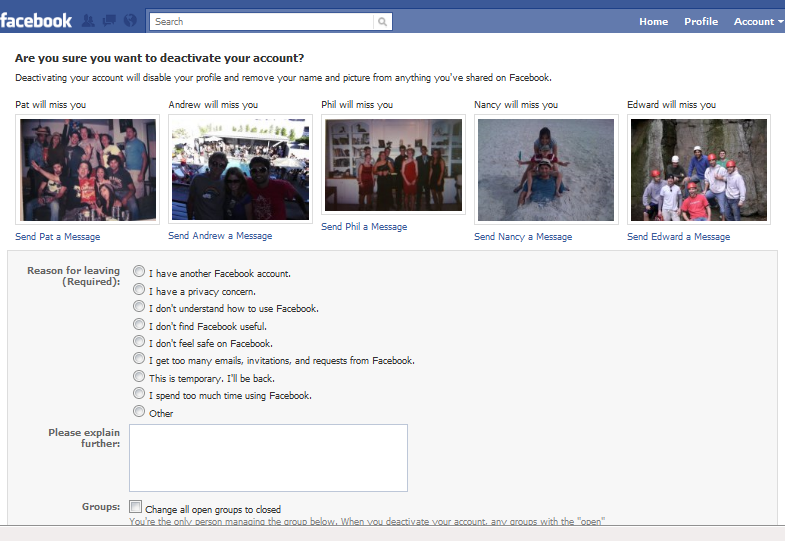
In August, I deactivated my facebook account, and temporarily cut myself off from almost 1400 people, becoming a facebook refugee. I chose ” I do not understand how to use facebook” as my reason for deactivating from the choices shown above and did not explain further. One month later, here is the explanation.
I had become fed up with the dependence on the website to keep in touch with people. I had traveled across the country the week before, reconnected with several old friends who I haven’t seen in years, and developed a theory that facebook had cheapened conversations with my normal correspondences. In addition, while watching the previews for INCEPTION, in Omaha, I was disturbed to see that there is a movie coming out about this thing very soon.
I think that social networking might be getting out of hand, and wanted to see what life was like without it, at least for a month, and thus deactivated my account. The short term absence from it gave me some ideas for new academic research that I might collaborate with my mentor at U of L.  The alienation from the community is definitely impactful, especially to someone who has moved to a new place with limited contacts in the area. I realized in my first month, facebook-less in the city of Louisville, that the people I started meeting were forming an impression of me because I wasn’t eligible to be their online friend. Mostly, these impressions were not favorable. And it’s this behavior that is fascinating to me. Too often journalists warn about negative impressions employers, co-workers, friends and lovers form of us based on what we do on the book, but I have yet to see anything talking about the consequences that the offline community faces. I estimate that less than 2% of my friends are not on facebook. They’ve missed out on seeing thousands of pictures, getting early notices on earthquakes, invitations to exclusive parties, status updates about their friends dog, and other information that fascinates us in our online lives.
In the process of deactivating my account, I backed up my pictures, obtained email address from 25% of my friends who responded to my going away status message, and did some research on other facebook refugees. What i found was quite interesting….
Apparently, 1 million people a year try to delete their facebook accounts, but stop when they get to the page shown in the screenshot picture in the beginning of this post. I found that page to be quite manipulative, showing pictures of me with close friends, and telling me that we will not be able to keep in touch. Some nerve! The people shown in this picture include some of my best friends from California, former bandmates, family members, and a business partner. I tested this out a few times, and somehow they managed to keep the same formula, but replaced the people with my mother, brother, former boss, and best friend from kindergarten. The notion that I would no longer be able to keep in touch with them is outrageous, and an indication of how this website has outgrown itself. Mark Z once made a statement about how facebook can do more social good than non profits and individual people…
There was a time when if you typed the word “Delete” into Google, the automated text following would be “facebook account.” To counter this, facebook made it very difficult to deactivate, or even delete. Accounts are not actually deleted for 14 days, and deactivating an account is just temporary. Deactivated users still get emails about events and activity on facebook, and in my experience, more of it. It is nearly impossible to export your contacts (they claim there is a way to do it through Yahoo, but it did not work for me.) Backing up my pictures took an hour or 2, because I had to save each one individually because none of the applications actually worked. Deactivating my account also removed pictures I tagged of other people, leading to an angry phone call from my little brother who lost his profile picture of surfing a wave in the pacific.
I maintained contact with many friends during my time off, but I did notice several people missing from my life. I missed having people share silly youtube links, new music, pictures from a houseboating trip, or others things that I admit enjoying on the facebook. Although these things were trivial in nature, it was a gloomy stage that I will not forget from my mid twenties.  Is society allowing facebook to have a monopoly over our friendships?
Here are experiences of others turning their backs on facebook….
Yesterday, I logged back in to my account, after realizing that my family was offended that I had done this. My grandmother’s brother had reached out to me through facebook from a remote village in the jungles of India the day I had deactivated, and I had snubbed him by not accepting. The moment I accepted his friendship, he posted a very kind message on my wall saying: “
“Hi Jason, I hope u r keeping, where r u ? and what are you doing ?, keep me in ur prayers as I often rememember u. God bless u always love Richie [ponkey]”
Suddenly I was bombarded with chats from people in Bombay, Hyderabad, Australia, Europe, California, New York, and even Canada. I got sucked back into the newsfeed, and realized that it was not the time for facebook and me to part. However, I have a new perspective on this thing, and suspect that someday I will have a better opportunity to move away from this culture without being alienated from the people I care about. When that day comes, I hope you will be with us.
 rss feed